Ph.D. candidate Shweta Dutta recently traveled to Horseshoe Island in Antarctica as part of her research to investigate and gain a deeper understanding of a mysterious electromagnetic wave phenomenon known as "whistlers".
Embarking on an Unexpected Journey
In the quest for deeper insights into science and the natural world, extraordinary journeys sometimes become necessary. Examples like Charles Darwin's voyage aboard the HMS Beagle and NASA's Apollo missions exemplify such endeavors, demanding extensive travel to uncover new realms of knowledge.
For Shweta Dutta, a Ph.D. student at Georgia Tech, a recent pursuit of discovery led her unexpectedly to the Turkish Antarctic Research base on Horseshoe Island, Antarctica.
“The opportunity came suddenly,” Dutta reflected on her February 2024 expedition. “Originally slated for a colleague, a last-minute change led me to prepare for this Antarctic venture in less than a month.”
Dutta's routine in Georgia Tech's School of Electrical and Computer Engineering, under Professor Morris Cohen's guidance, swiftly transformed into a multimodal journey to the southernmost extremes of our planet.
Collecting "Whistler" Data
Her mission: to evaluate the Antarctic site's suitability for deploying her lab’s very low-frequency (VLF) antenna system. This system aimed to capture "whistlers" — electromagnetic waves descending in frequency over time, originating from lightning strikes and VLF energy emitted through the ionosphere.“Our focus on whistler phenomena is critical in understanding how the Earth's upper atmosphere discharges excess energy and charged particles,” she explained. “This has implications for satellite longevity and terrestrial power grids during severe solar storms.”
The expedition began with flights from Atlanta to Santiago, Chile, then Punta Arenas, Chile. From there, a DAP-operated charter plane transported Dutta to King George Island, followed by a ship journey to Horseshoe Island aboard the Betanzos.
Living aboard the Betanzos alongside Chilean crew members and 25 fellow researchers from various disciplines, Dutta spent four weeks navigating the icy waters and conducting daily trips to Horseshoe Island.
“Languages varied aboard — Turkish, Spanish, Bulgarian — but English prevailed for communication,” Dutta remarked. “Despite the remoteness, regular calls with family and my boyfriend kept me grounded.”
Ideal Terrain for Research (and Penguins)
Despite its challenges, Horseshoe Island's location offered ideal conditions for studying whistlers, positioned near the magnetic field line's base over northeastern North America. Combined with receivers along the U.S. eastern seaboard, this location promised insights into these electromagnetic phenomena.
Established in 2017 by Turkey, the base consists of three container buildings, powered by day via generator due to the absence of sufficient infrastructure for year-round operation.
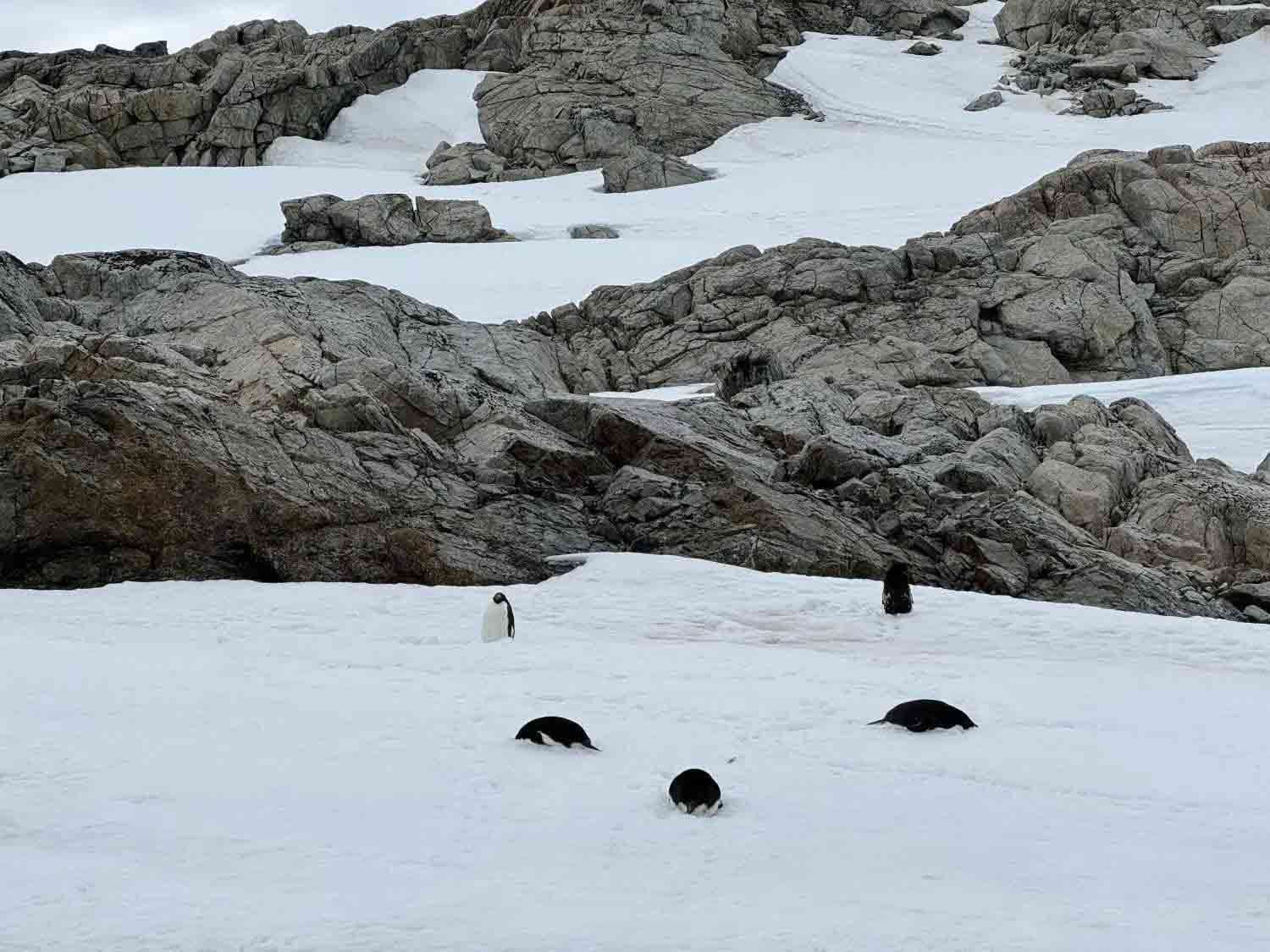
Antarctica's unpredictable yet stunning landscape provided Dutta encounters with penguins, leopard seals, whales, and skuas — seabirds known for their predatory habits.
“The penguins’ curiosity amazed me most; two of them explored our containers, squawking and observing our work,” she recalled.
The Journey Home
After fourteen days of intensive research and amassing 800 gigabytes of initial data, Dutta prepared for her return. However, adverse weather conditions delayed their departure from King George Island for two additional days due to fog.
Returning to Georgia Tech on March 2, Dutta eagerly anticipated the Low Frequency Radio Group's analysis of her findings.
Looking ahead, continuous data collection remains paramount for Dutta and her team. Their goal includes returning with a battery-powered receiver for uninterrupted data recording.
“Having previously conducted research in Puerto Rico and Kansas, this Antarctic experience stands out remarkably different,” Dutta reflected. “Working here as a Ph.D. student is undoubtedly a highlight of my life.”