Scientists have discovered that a river comparable in size to the Rio Grande once flowed through West Antarctica, providing a rare glimpse of the continent's land before it was covered in ice.
This 900-mile-long river is believed to have existed around 44 to 34 million years ago, just before the formation of Antarctica's massive ice sheets.
During that period, which followed the age of dinosaurs and preceded human life, Antarctica enjoyed a mild climate and possibly hosted giant penguins, explained Cornelia Spiegel from Germany's University of Bremen. This finding also indicates that West Antarctica was above sea level at that time.
"We discovered that before West Antarctica was ice-covered, it featured a large river system, a temperate climate (with summer river surface water temperatures around 19°C), and a swampy environment," Spiegel told Newsweek via email. "The river likely meandered through a vast coastal plain with boggy swamplands along its banks."
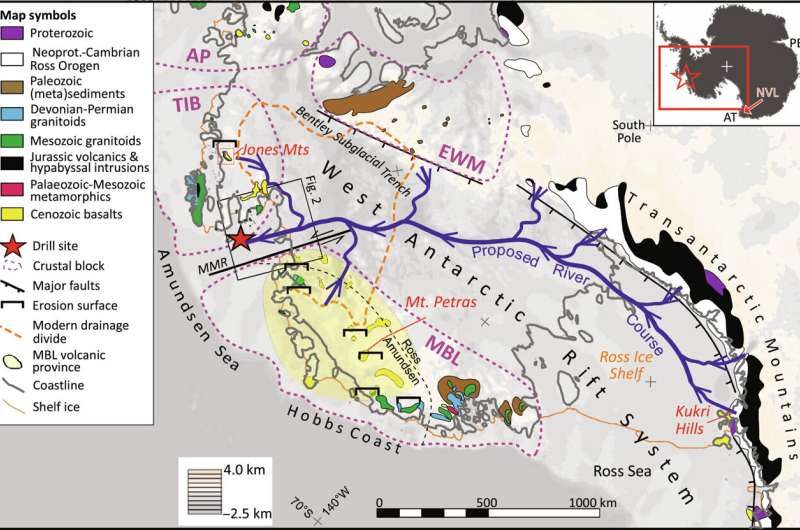
An international team of scientists uncovered this river by analyzing sandstone rock samples from beneath the Amundsen Sea Embayment, where the West Antarctic Ice Sheet meets the ocean. In this rock, dating back to the Eocene period (56 million to 34 million years ago), they found sediments that originated from the Transantarctic Mountains, suggesting they were transported by an ancient river.
The researchers also identified organic chemicals linked to freshwater bacteria, further indicating the presence of a large river delta in the region. This river stretched from the Transantarctic Mountains to the West Antarctic Ice Sheet and drained into the Amundsen Sea, as reported in the journal Science Advances. Spiegel noted that their study shows West Antarctica was mostly above sea level but relatively flat, which likely kept it free of large glaciers, unlike the mountainous regions of East Antarctica that began to freeze around 34 million years ago.
The scientists hope this river discovery will enhance the understanding of Antarctica's geographic history and how it became the frozen continent known today. "Major Antarctic glaciation started at the Eocene-Oligocene transition 34 million years ago, a period marked by significant global cooling," the researchers stated. They emphasized that reconstructing Antarctica's pre-transition conditions is crucial for understanding the subsequent cooling and glaciation, which has significant implications for ice sheet modeling.